



LSU is Training Tomorrow’s Doctors to Treat the Root Causes of Disease
April 29, 2026
In Louisiana, food is more than nourishment; it’s culture.
Family recipes are passed down for generations. Communities gather around crawfish boils, Sunday gumbo, and neighborhood cookouts and tailgates. Across the state, food is woven into celebrations, traditions, and identity.
“By integrating academic training with research and patient-centered care, the LSU Research Flagship is developing solutions that benefit Louisiana communities and have broad national significance.”
LSU Chancellor Jim Dalton
But the same culture that celebrates rich culinary traditions also exists alongside some of the nation’s most serious health challenges.
Louisiana consistently ranks among the states with the highest rates of chronic disease. About 40 percent of adults in the state have obesity, significantly higher than the national average of 32.8 percent. Obesity is a major risk factor for conditions such as type 2 diabetes, heart disease, stroke, and hypertension. Louisiana ranks third in the nation for childhood obesity.
Nutrition also plays a critical role in mental health, physical growth, maternal health, fetal development, and immune function. These conditions affect families and communities across the state and are among the most common issues physicians encounter in clinics and hospitals.
Yet historically, nutrition, the factor at the center of many of these conditions, has received relatively limited attention in medical training nationwide. That focus is beginning to change.
LSU’s two medical schools, LSU Health Sciences Center New Orleans and LSU Health Shreveport, are part of a nationwide group of medical schools recently committing to expand nutrition education for future physicians, agreeing to provide at least 40 hours of nutrition instruction or equivalent competency beginning in the Fall of 2026.

An LSU Health Shreveport School of Medicine student receives her white coat.
– Photo: LSU Health Shreveport School of Medicine
Together, they are strengthening how future physicians learn to address chronic disease—not only through treatment, but also through prevention.
For LSU, this initiative builds on the university’s strategic priorities and tradition of interdisciplinary collaboration across the new Flagship to address critical challenges, including chronic disease, preventive care, and physician workforce development, leveraging research strengths and educational excellence across all five campuses.
“By integrating academic training with research and patient-centered care, the LSU Research Flagship is developing solutions that benefit Louisiana communities and have broad national significance,” said LSU Chancellor Jim Dalton.
Building a Stronger Foundation in Nutrition Education
For physicians practicing in Louisiana, understanding the connection between food, lifestyle, and health outcomes is critical.
“By providing a longitudinal nutrition curriculum that builds on basic science knowledge and focuses on the care of patients, we can better prepare future physicians and healthcare professionals to approach treatment and disease prevention more holistically,” said said Dr. Robin English, Associate Dean of Student Affairs, LSU Health New Orleans School of Medicine. “This curriculum will equip them to help patients improve their understanding of nutrition, adhere to treatment and prevention guidelines, and enhance overall health literacy.”
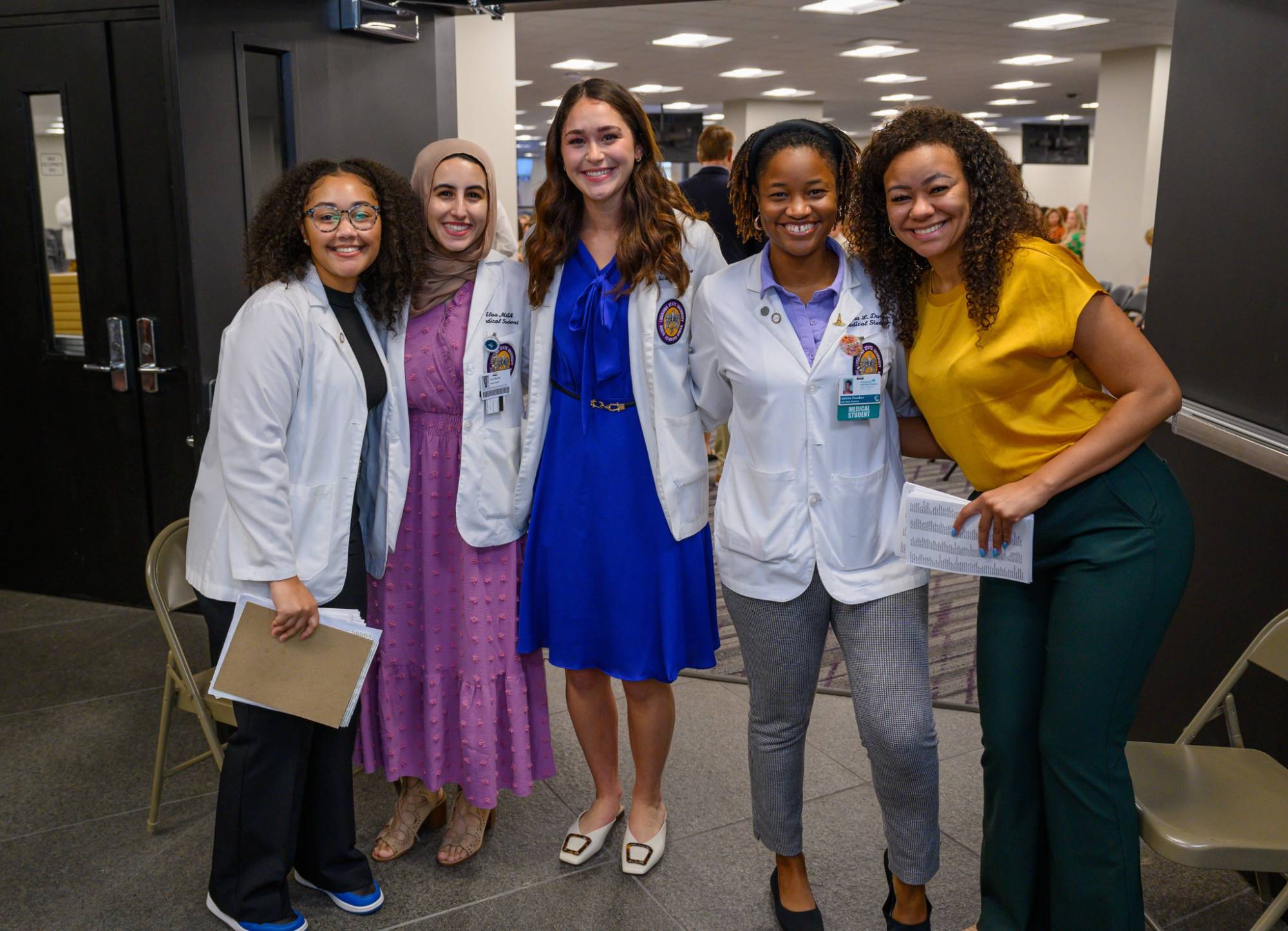
Members of LSU Health New Orleans' School of Medicine Class of 2028 participate in their White Coat Ceremony
– Photo: LSU Health New Orleans School of Medicine
At LSU Health New Orleans, leaders are conducting a comprehensive assessment of the medical school’s curriculum to identify where nutrition is already being taught and how those lessons can be strengthened.
Using a curriculum database and national nutrition competency frameworks, faculty are mapping existing coursework to key learning areas, including foundational nutritional knowledge, patient counseling, and public health nutrition.
“In short, we have committed to broadening our nutrition education curricula,” said English, LSU Health New Orleans.
Currently, the curriculum includes instruction across several domains, including Foundational Nutritional Knowledge, Nutrition Assessment and Diagnosis, Communication Skills, and Public Health Nutrition. The goal is to build a stronger, more coordinated approach to teaching nutrition across all phases of medical training, from classroom learning to clinical rotations.
Like LSU Health New Orleans, LSU Health Shreveport’s School of Medicine is implementing a longitudinal, competency-based approach to nutrition education as well.
Instead of treating nutrition as a standalone topic, the curriculum integrates nutritional science throughout medical training, from foundational science courses to clinical experiences.
Students learn both the biochemical basis of nutrition and its application in patient care, including how diet influences conditions commonly seen in clinical practice, such as cardiovascular disease, diabetes, hypertension, and kidney disease.
“For example, if you have a patient who may be an early diabetic, and you may just take the dietary history, but if you don't understand the components of that diet that potentially may be putting that patient or tipping the pounds to be diabetic, you can't help that patient,” said Dr. Kelly Pagidas, Senior Associate Dean for Medical Education, Professor of Obstetrics and Gynecology at LSU Health Shreveport.
“So essentially by educating students who then would be physicians in training, and then subsequently physicians, they'll have the ability to apply the sciences to direct patient care.
Future enhancements will include new fourth-year electives in lifestyle and culinary medicine, allowing students to deepen their understanding of nutrition epidemiology, preventive health care, and even hands-on food preparation.
The approach reflects a broader shift in medical education: equipping physicians with tools to address the root causes of disease before it progresses.
“I'm extremely proud, and the reason that I'm proud is the potential to make a difference. The potential for our students, even if they decide not to stay here, to have a direct impact on being able to see a patient and practice evidence-based medicine,” said Pagidas. “Understanding nutrition is fundamental to prevention. Understanding that it's fundamental to a lot of the chronic diseases and outcomes. Part of our legacy is seeing our graduates contribute. And I think for us, for them to be able to contribute to something that potentially is reversible, that you have control over that doesn't necessarily rely on a procedure or a medication is profound.”
Advancing Research in Diet-Related Disease
Beyond the classroom, LSU researchers are also advancing the scientific understanding of diet-related diseases.
At LSU Health Shreveport, cardiovascular and metabolic disease research represents a major strength of the campus. The university’s Center for Cardiovascular Diseases and Sciences is a hub for studying cardiometabolic health, while a new National Science Foundation-funded research center is focusing on metabolic diseases, including obesity, diabetes, and liver disease.
These efforts help train the next generation of physicians and scientists while generating new knowledge about how nutrition influences long-term health outcomes.
A Systemwide Effort to Improve Health
The work underway at LSU’s medical schools reflects a broader commitment across the LSU enterprise to tackle complex health challenges through research, education, and community engagement.
Across the university system, researchers are exploring how nutrition, food systems, and lifestyle affect health outcomes.
LSU Health New Orleans is contributing to research that could reshape how nutrition is used to prevent disease. The Nutrition for Precision Health study, part of the national All of Us Research Program, aims to better understand how individual differences, from genetics to lifestyle, affect how people respond to different diets, with the goal of tailoring nutrition-based approaches to preventing chronic illness.
LSU Health New Orleans and LSU’s Pennington Biomedical Research Center are working closely together on the study and enrolling participants in this landmark initiative.
“The point of this grant is to correlate or understand how the body metabolizes food, but in the context of their own DNA, and that's what makes it ‘precision,’ said Dr. Judd Shellito, Lowenstein Professor of Medicine, Professor of Microbiology, Immunology and Parasitology at LSU Health New Orleans School of Medicine. “We've just been granted an extension for an additional year, and the reason we've been granted an extension is that our recruitment is one of the best in the nation.”
All of Us aims to engage at least 1 million participants in building a health database that reflects the diversity of the U.S., to help speed up medical research and enable individualized prevention, treatment, and care options.
“If we're on the right track, and we come up with some good results, this is the sort of thing that could be included in any medical school curriculum for teaching doctors about diet. And how to prescribe a diet in an individual,” Shellito said.
Pennington Biomedical Research Center’s Greaux Healthy initiative, developed in partnership with the state of Louisiana, aims to furnish communities with essential tools and programs grounded in over 35 years of research from Pennington Biomedical. The initiative focuses on four key populations: expectant families and parents of infants, preschool-aged children, school-aged children, and teens and young adults.
In addition, the Greaux Healthy Toolkit is a comprehensive resource designed to equip healthcare providers with practical, evidence-based guidance for preventing, evaluating, and treating childhood obesity and its related comorbidities.
This free resource offers a quick reference for evaluating obesity, as well as actionable treatment approaches for children and adolescents dealing with overweight and obesity.
Biomedical discovery, agricultural research, and community-based programs can be found on LSU’s Baton Rouge campus and through outreach throughout the state.
Efforts include:
- Nutrition and dietetics programs that prepare future health professionals: LSU offers concentrations in Dietetics, Nutritional Sciences/Pre-Medical, Nutrition, Health, and Society, and Food Science and Technology (with Pre-Medical Option).
- 100% acceptance for dietetic internships: Since 2020, every student who applied for a dietetic internship has been accepted. Since 2023, 100% of our dietetics students who applied to graduate school were accepted.
- Research at the LSU AgCenter focused on food systems, agriculture, and public health
Together, these efforts demonstrate the breadth of LSU’s research enterprise and its role in addressing challenges that affect communities across the state.
The expanded focus on nutrition education arrives at a time when LSU is working to strengthen its research enterprise and deepen collaboration across disciplines.
The university has set an ambitious goal of becoming a Top 50 research university, with a focus on solving some of the most pressing challenges facing Louisiana and the world.
Training physicians who understand the connections between nutrition, lifestyle, and chronic disease is one piece of that broader mission. By combining medical education, research, and community engagement, LSU’s health sciences campuses are helping prepare a new generation of doctors to treat and prevent disease.